Last updated: 2026-08-01 by Ted Sellers, Owner
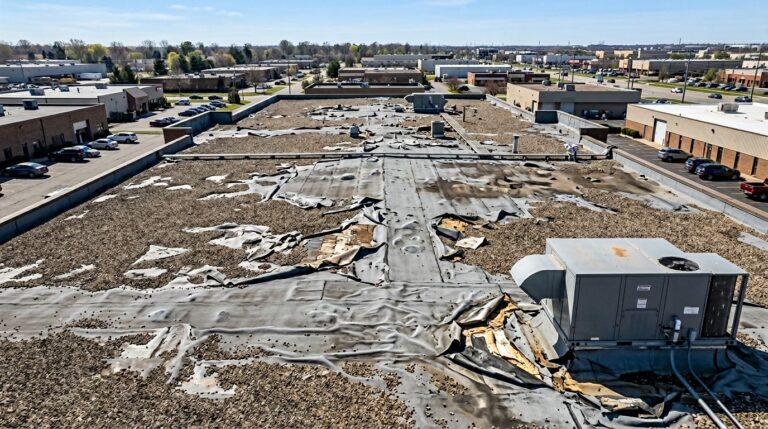
A flat roof parapet leak usually comes from one of three places: the roof membrane’s transition to the parapet wall, the metal coping on top, or a drainage opening that cuts through the parapet (like a scupper). To find it, start by tracing interior staining to the closest wall line, then inspect parapet flashings, terminations, coping joints, and scupper liners. Finally, confirm with controlled water testing or professional moisture mapping.
When This Applies
When a parapet-wall leak search makes sense
This approach fits most commercial buildings with a roof slope and a raised perimeter parapet wall. It’s especially useful when you see ceiling staining near an exterior wall (signs of water infiltration that risks moisture sensitive framing), water on masonry, or wet insulation along the roof edge.
Parapets are like a curb around a bathtub. They help with wind uplift and aesthetics, but they add seams, joints, and terminations. Those details age faster than open field membrane, so the parapet wall line becomes a common leak zone.
If you’re reviewing parapet leak risks or repair details, it helps to understand how flashing should work at these wall transitions. This parapet wall flashing guide explains why parapet edges fail so often.
When it probably isn’t the parapet
Sometimes water shows up near a wall but enters elsewhere. Skip the parapet as the primary suspect if:
- The leak appears under rooftop penetrations far from the edge.
- The roof has no parapet (a simple edge metal detail instead).
- The “leak” is seasonal condensation, for example sweating ductwork or cold-wall vapor issues.
Also, if the interior leak is centered near a drain line, the source may be a clogged drain, split drain bowl flashing, or ponding water, not the parapet. Water on the masonry can breach the weather resistant barrier behind the assembly.
Edge cases that fool building owners and maintenance teams
Wind-driven rain can push water upward and sideways. In that case, a tiny opening at a coping joint can soak wall insulation without leaving obvious roof-surface clues.
Freeze-thaw cycles add another twist. Water gets into a hairline crack in mortar or a coping seam, freezes, expands, and widens the path. After a few seasons, what started as a pinhole acts like a small gutter behind the wall.
If the leak only happens during storms with heavy wind, think “edge details” first, not the middle of the roof.
Step-by-Step
Prep work that prevents wasted repairs
- Pick one target leak and map it, because multiple leaks can overlap. Mark interior ceiling tiles, wall staining, penetrations near the wall, and the nearest exterior wall line.
- Document recent conditions (snowmelt, wind direction, rainfall amount, HVAC service). Timing often points to the entry detail.
- Get roof access safely and avoid “quick walks” during wet or icy conditions. If you can’t do it safely, pause and schedule a professional inspection.
Trace the leak path from inside before you go on the roof
- Measure from two fixed points inside (grid lines, columns, or exterior corners), then transfer those measurements to the roof. Flat-roof leaks travel, so don’t assume the drip is directly below the hole.
- Look for the highest wet point on walls and deck lines. Water typically stains at the first place it escapes the assembly.
- Check parapet wall-adjacent penetrations inside, such as conduit that exits near the perimeter, because water can track along pipes and sleeves in the roof membrane.
For a simple explanation of why flat-roof leaks “move,” this overview of finding the source of a flat roof leak aligns with what many commercial inspections uncover.
Inspect parapet details on the roof (where leaks usually start)
- Start at the coping cap and inspect every seam. Look for open joints, loose cleats, missing fasteners, split sealant, and bent metal at corners. Pay extra attention to end laps, splice plates, and the coping cap edges.
- Follow the waterline down the outside face and then back to the roof side. Cracks in masonry joints, failed sealant at counter flashing, or gaps at reglets can funnel water behind the flashing.
- Inspect the roof membrane-to-wall transition along the entire run. At inside corners and angle changes (especially where a can strip or tapered edge strip supports the transition), look for roof membrane splits, fishmouths, buckles, deteriorated wall flashing, or termination bars pulling away.
- Check terminations and “hidden laps” where the roof membrane ends under metal counter flashing. If the termination bar has gaps, missing fasteners, or sealant voids, water can slip behind and travel laterally.
- Inspect scuppers, overflows, roof drains, and downspouts that pass through parapets. A failed scupper liner seam, deteriorated corners at the scupper, or a blocked scupper opening can cause water to back up and rise high enough to enter wall flashing. Check for a cricket to direct water to the drainage points, including secondary emergency drains.
Confirm the exact entry point without soaking your building
- Use controlled water testing only after the roof is dry and your team is ready inside. Start low, then move upward in small sections. Keep the hose flow steady, not blasting. Stop as soon as water appears indoors.
- Don’t ignore moisture trapped in the system. If you suspect saturated insulation along the parapet line, consider professional moisture mapping and verification. For large facilities, targeted diagnostics can save you from tearing into the wrong area. A dedicated service like commercial roof leak detection in Saint Paul is built for that kind of pinpointing.
Decide what “fixed” really means for a commercial parapet leak
- Match the repair to the failure mode. A single open coping seam may need re-seaming, liquid applied flashing reinforced with fleece, or a new splice detail. A failing wall transition might need new flashing and a corrected termination height.
- Escalate when patterns show up. If you find repeated open seams, widespread wet roof membrane, or fatigued flashing details at multiple parapet sections, your commercial roof needs repair beyond a spot patch. At that point, plan for a scoped commercial flat roof repair project, or evaluate whether commercial roof replacement is the smarter long-term move.
What to Do After You Locate the Parapet Leak
Choose a repair scope that protects your budget
Once you’ve confirmed the entry point, the next decision is scope. Some fixes are surgical, while others need a broader approach because water has already traveled and saturated materials.
Here’s a quick way to frame the decision:
| What you found at the parapet wall | What it often means | Typical next move |
|---|---|---|
| One open coping joint, dry insulation nearby | Localized entry at metal flashing seam | Detail repair, then re-check after next storm |
| Loose termination bar, cracks at corners | Movement and repeated stress | Reflash transition flashing at the roof membrane-to-wall connection, correct terminations |
| Wet insulation along long parapet runs | Water traveling inside the system | Moisture mapping, sectional tear-off and replacement |
| Multiple failing details, aging system | End-of-life symptoms | Restoration plan or commercial roof replacement |
The main takeaway is simple: the leak you see is rarely the only damage. The longer moisture sits, the more expensive the fix becomes.
A cheap patch on a wet system can buy time, but it can’t buy back lost insulation performance.
FAQ
Why does a parapet leak show up 20 feet away from the wall?
Water moves like it’s following a hidden hallway. On low-slope roofs, it can travel across the deck or inside insulation layers, breaching the water control layer at seams such as a gap or fastener line.
When this happens most
This is common after repeated wetting, when insulation joints open and create easy pathways.
What if it only leaks during wind-driven rain?
Wind can push water up parapet faces, forcing hydrostatic pressure into coping cap joints, reglets, and counter flashing gaps. In those cases, a roof can pass a calm-rain test and still leak in a storm.
What to look for first
Prioritize coping cap seams, corner caps, and counter flashing terminations before you assume the field membrane failed.
Are scuppers part of parapet leak problems?
Yes, because scuppers cut through the parapet and interrupt flashing continuity. If the liner corners crack, seams split, or the scupper clogs, water rises and presses on details that don’t normally sit underwater, building pressure against liquid applied flashing or sealant.
A quick clue
Rust staining, peeling coating, or softened wall materials below a scupper often points to leakage at that penetration.
Can I just re-caulk the parapet and call it done?
Sometimes, but sealant is rarely the full answer. Sealant works best as a finishing component in a correct detail, not as the detail itself. If metal is loose, flashing heights are wrong, membranes have pulled back, or the termination bar shifts, sealant becomes a short-lived bandage.
When sealant makes sense
Use it when the underlying assembly is secure and you’re sealing a sound seam, not bridging movement or gaps.
How do I know it’s time to stop patching and replace the roof?
If you’re chasing new leaks each season from ultraviolet light degrading seams in EPDM rubber, TPO, PVC, or a torch down roof, finding widespread wet insulation, or repairing the same parapet transitions repeatedly, patching turns into a recurring operating cost. At that stage, it’s worth pricing repair versus commercial roof replacement based on remaining service life and business risk.
A practical rule for owners
When downtime risk and interior damage costs outrun the price difference, replacement usually wins.
Conclusion
Finding a flat roof parapet leak is about narrowing the path, not guessing. Trace the interior clues, inspect parapet wall coping, flashing, and transitions closely, then confirm with controlled testing or diagnostics at the roof membrane. When you match the repair to the true failure point, you stop repeat leaks and protect your building’s operations. If you’re seeing recurring edge leaks, schedule a targeted parapet wall inspection before the next storm decides for you.
Need a roof inspection in Saint Paul or the Twin Cities? Call Sellers Roofing Company at +1-651-703-2336 or schedule a free estimate. We are a black-owned, NMSDC-certified MBE roofing contractor with 9+ years experience.