Last updated: 2026-08-01 by Ted Sellers, Owner
Short answer: If roof damage deductible Minnesota leaves the repair cost below your coverage threshold, insurance usually won’t pay anything, so you cover the job yourself. That is common with small membrane patches from storm damage, isolated flashing issues, or minor leak work. In Minnesota, a roofing contractor cannot legally waive your deductible or rebate it, so the real question is whether the full scope is larger than it first looks.
Key Takeaways
- If roof damage repair costs less than your deductible in Minnesota, insurance pays nothing—you cover it fully, and contractors cannot legally waive or rebate it under Minnesota Statute § 325E.66.
- Always start with a professional roof inspection: small leaks or stains often hide wet insulation, failed seams, or broader damage that pushes costs over the deductible.
- Compare the full line-item estimate (tear-off, membrane, depreciation) to your deductible type (flat or percentage) before filing a claim or skipping it.
- Opt for commercial flat roof repair on limited damage or commercial roof replacement if widespread issues like repeated leaks make patching inefficient long-term.
- Document everything with photos, moisture readings, and notes—even without a claim—for future proof if damage worsens.
When This Applies
If the repair estimate stays under the deductible
This rule applies when the cost to fix the covered damage is less than the deductible in your insurance policy. For many commercial owners in the Twin Cities, that means a small leak, one damaged penetration, or a limited area of commercial flat roof repair will stay out of insurance claim territory, even before involving an insurance adjuster.
A quick estimate can be misleading, though. Flat roofs hide moisture well, and a small opening can send water farther than the ceiling stain suggests. That is why a roof damage deductible in Minnesota should never be judged by one photo or one drip.
| Deductible type | How it works | What it means for you |
|---|---|---|
| Flat deductible | A fixed dollar amount | The repair total must pass that amount before insurance payment starts |
| Percentage deductible | A share of the insured value | The out-of-pocket amount can be much higher on larger commercial properties |
A repair that costs less than the deductible usually stays a maintenance expense, not an insurance payment.
When the rule does not apply
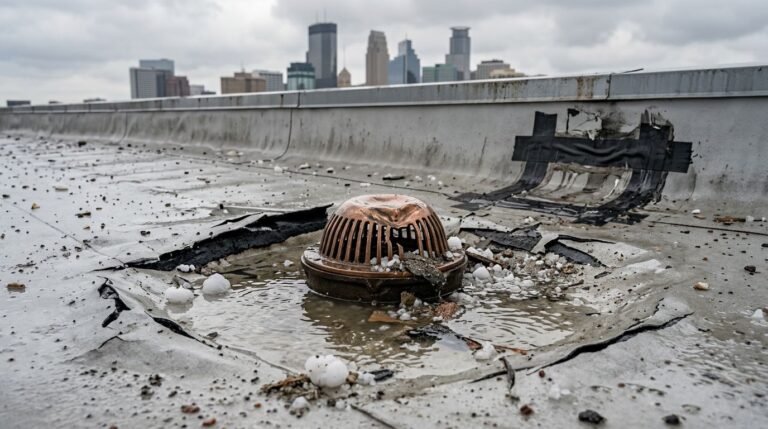
The deductible is not the only issue when hidden damage is involved. Tear-off can expose wet insulation, broken seams, crushed edge metal, or damaged decking. In those cases, the first estimate may no longer match the real job.
That is also where professional commercial roof leak detection helps. A good roof inspection can show whether the loss is truly small or whether the roof has broader damage that was not visible at first.
Minnesota law matters here too. Under Minnesota Statute § 325E.66, a contractor cannot pay your deductible, waive it, or hide it in the price, as outlined in standard insurance policy language per Minnesota Statute § 65A.01. That means the quote, invoice, and claim file all need to show the real cost. If a roofer offers to “take care of” the deductible, that constitutes insurance fraud.
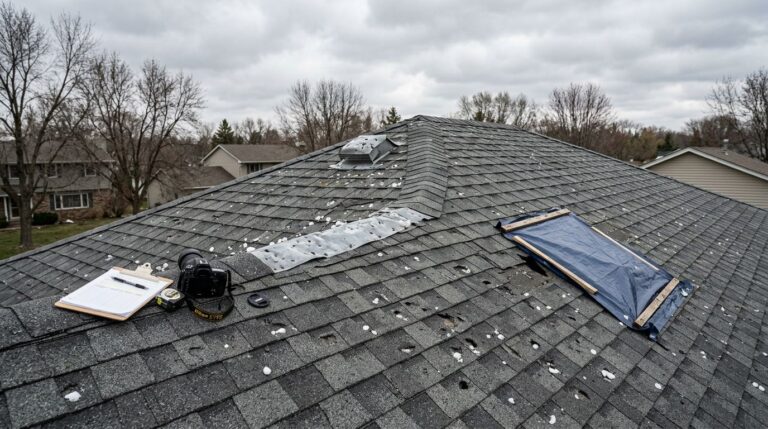
For storm claims involving hail damage or wind damage, it also helps to compare the repair cost with the policy math before you decide what to do. A commercial roof hail damage inspection can show whether the damage is mostly cosmetic or whether it affects the roof’s function.
Step-by-Step
1. Get the full scope before you think about the claim
Start with a professional roof inspection from a licensed roofing contractor, not a guess. Ask for photos, measurements, moisture findings, and a line-item estimate. If the roof is actively leaking, follow the steps in what to do if you find roof damage so the problem does not spread while you wait.
Temporary dry-in work is fine. In fact, it is smart. Tarping, leak tracing, and small emergency patches protect the building and preserve evidence. They do not weaken your claim.
2. Compare the estimate to the deductible, line by line
Do not look only at the total. Check tear-off, membrane squares, insulation, flashing, edge metal, drains, disposal, permits, and equipment time. Many owners assume the roof is “below deductible” because the first number is low, but the scope of loss is missing key items like recoverable depreciation.
An insurance adjuster might calculate the repair total using actual cash value or replacement cost value. Initial estimates often overlook how actual cash value depreciation affects the payout, while replacement cost value can increase the total once recoverable depreciation is addressed. If the total still falls short, filing a claim may not produce a check. If the cost is close, ask the roofer to explain what could change after opening the roof. That is often where the real answer shows up.
A small claim with a low repair bill may still be worth documenting, but it often does not need to be opened if the work is clearly below the deductible. For a closer look at claim math, see roof hail damage claims for minor damage.
3. Check for hidden damage before you close the door on coverage
A roof can look minor from the ground and still hide a bigger problem. Wet insulation, membrane shrinkage, open seams, and failed flashing can turn a small leak into a wider loss. Review your insurance policy to understand coverage for these issues. If your commercial roof needs repair and the damage keeps showing up in new spots, get a deeper inspection before you settle on a repair-only view; check your insurance policy again for hidden damage provisions.
This is where a second look matters. If the inspection finds more damage than the first walk-through, the scope can shift from a spot fix to a broader repair package. In some cases, you may need to file the claim or prepare a supplement claim, especially after an insurance adjuster reviews the expanded findings. The work no longer makes sense as a patch at all.
4. Decide whether repair or replacement fits the roof
If the damage is limited and the rest of the system is dry, commercial flat roof repair is often the right answer. If the roof has widespread wet insulation, repeated seam failure, or major wear across the field, commercial roof replacement may cost less over time than repeat patching, especially if building code or ordinance or law requirements apply and push the project over the deductible.
For a useful side-by-side view, the guide on deciding between roof repair and replacement can help frame the choice. The best answer is the one that stops water and fits the condition of the roof, not the one that feels cheapest for the day.
If you are still unsure, ask one question: will the repair solve the cause, or only cover the symptom? If it only covers the symptom, the roof probably needs more than a patch.
FAQ
Can I still file a claim if the damage is below my deductible?
Yes, but the insurance claim may not pay anything if the approved loss stays under the deductible. That is why many owners wait for a full inspection first before they file the claim. If hidden damage or code-required work pushes the cost higher, the answer can change.
Does Minnesota allow a roofer to pay my deductible?
No. Minnesota Statute § 325E.66 does not allow a roofing contractor to pay, waive, or rebate a deductible. The deductible belongs to the policyholder. Any proposal that hides it instead of showing it clearly should be treated with caution.
What if the first estimate for shingle damage is under deductible, but the roof still leaks?
Then you probably need a better look at the leak path. Water often travels under the membrane, through insulation, or around penetrations before it shows inside. A focused leak trace can reveal functional damage the first estimate missed.
When should I consider replacement instead of repair?
Replace when the damage is widespread, the insulation is wet in several areas, or the seams and flashing are failing across much of the roof. At that point, repeated service calls can cost more than a planned rebuild.
What if I disagree with the insurance adjuster?
If you disagree with the insurance adjuster, consider submitting a proof of loss, hiring a public adjuster to help advocate for you, or invoking the appraisal clause in your policy to settle the dispute.
Do I need photos if I do not file a claim?
Yes. Photos, dates, moisture readings, and contractor notes give you proof if the roof gets worse later. They also help if the carrier or a future buyer asks what changed and when it changed.
Conclusion
When roof damage is below your roof damage deductible in Minnesota, insurance usually does not pay, and the job becomes a direct repair expense. That is normal. The mistake is deciding too early, before anyone checks the full scope.
The real number is not the first stain or the first patch price. It is the full repair scope, the hidden damage, and whether the roof is headed toward commercial flat roof repair or roof replacement.
For commercial owners, the safest move is simple: work with a licensed roofing contractor to thoroughly document the damage and review your insurance policy, compare the estimate to the deductible, and make the repair decision from facts, not guesswork. This approach also helps you avoid being misled by storm chasers or your roofing contractor rushing the process.
Need a roof inspection in Saint Paul or the Twin Cities? Call Sellers Roofing Company at +1-651-703-2336 or schedule a free estimate. We are a black-owned, NMSDC-certified MBE roofing contractor with 9+ years experience.