Last updated: 2026-09-28 by Ted Sellers, Owner
Lost rent after a roof storm can affect a building owner long after the rain stops. This article explains the documentation that matters, the difference between property damage and income coverage, and why the policy must be read before relying on an assumption.
Does Commercial Insurance Cover Lost Rent After a Minnesota Roof Storm?
Commercial insurance may cover lost rent after a Minnesota roof storm only when the policy includes applicable business-income or rental-value coverage and the loss meets its conditions. Document the storm damage, repair timeline, tenant impact, and financial records, then review the exact policy language.
Commercial insurance lost rent coverage can pay after a Minnesota roof storm when a covered peril causes direct physical damage and the policy includes business income, rental value, or loss-of-rents coverage. Property coverage alone usually pays to repair the building, not the rent shortfall.
Payment is limited to the actual income lost during the restoration period. Deductibles, waiting periods, vacancy clauses, exclusions, policy limits, and lease terms all matter.
When Commercial Insurance Lost Rent Coverage Applies
A covered storm must make space unusable
This applies to owners of rented offices, retail space, warehouses, apartments, and mixed-use buildings. Wind, hail, falling tree debris, or another covered event must cause direct physical damage at the insured property. That damage must prevent normal operations, occupancy, or rental use.
The policy may call this protection business income, business income including rental value, rental value, or loss of rents. The NAIC’s business interruption coverage overview explains that this coverage replaces lost income after covered property damage forces a suspension.
A commercial insurance lost rent claim also needs a real financial loss. If a tenant continues paying under the lease, the owner may have no lost-rent amount to recover for that suite. Owner-occupied space may involve business-income coverage rather than rental value.
Common reasons a claim falls out
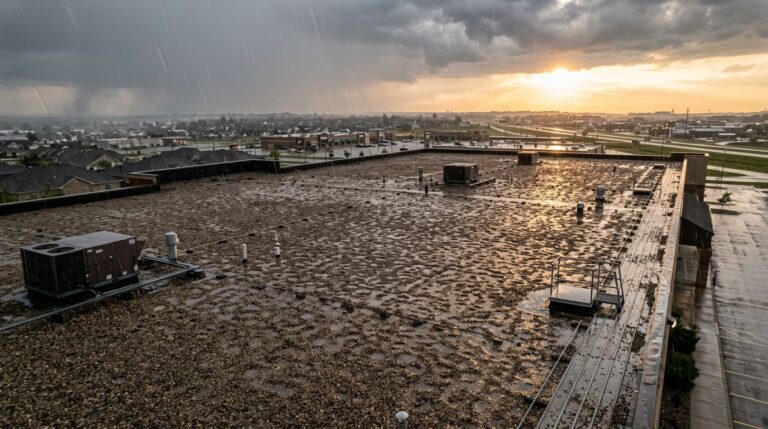
A storm damage roof does not automatically trigger rent coverage. The carrier will look for a covered cause, a physical opening or damaged roof component, and a direct link between that damage and the lost income.
Coverage often fails when the loss stems from long-term leakage, poor maintenance, clogged drainage, wear, or an excluded flood event. Many policies also impose a waiting period, often 72 hours, before time-element payments begin. A commercial insurance lost rent claim can also be reduced when a building was vacant before the storm or the lease did not allow rent abatement.
Step-by-Step: Build the Lost-Rent Claim File
Stop active damage without destroying evidence
- Open the roof insurance claim promptly. Report the storm date, the known damage, active leaks, and affected suites. Stick to facts you can support, such as “wind lifted membrane at the north parapet and water entered below the seam.”
- Protect the building from added damage. Temporary tarping, interior water control, and emergency seam sealing are reasonable mitigation. If water is entering now, Call 651-703-2336 for 24/7 Emergency Roofing. Avoid broad permanent work before the condition is photographed and documented.
Establish what damaged the roof and where water traveled
- Order a system-specific commercial roof inspection. The report should identify the material, damaged details, likely cause, moisture spread, emergency work performed, and whether the roof is repairable.
- Trace the source when the interior stain does not match the roof opening. Commercial roof leak detection can document moisture readings, leak paths, and conditions below the membrane before repair work changes the evidence.
Prove the income loss and restoration period
- Give the adjuster rent rolls, signed leases, tenant ledgers, rent-abatement notices, prior income statements, and correspondence showing why rent stopped or dropped. A commercial rental property insurance guide describes how rental-value coverage is tied to income the owner actually loses.
- Create a dated repair timeline. Show the storm date, first leak report, tenant disruption, emergency work, inspection date, repair start, and expected reopening. The commercial insurance lost rent calculation should follow the actual loss sustained during the covered restoration period, not a guessed number.
Roof Evidence That Can Change the Scope
A commercial flat roof needs system-specific proof
Membrane systems do not fail like shingle roofs. On TPO roofing and EPDM, inspect seams, perimeter terminations, flashing, drains, penetrations, and punctures. On modified bitumen and BUR, look for torn plies, failed laps, blisters, exposed areas, and wet insulation.
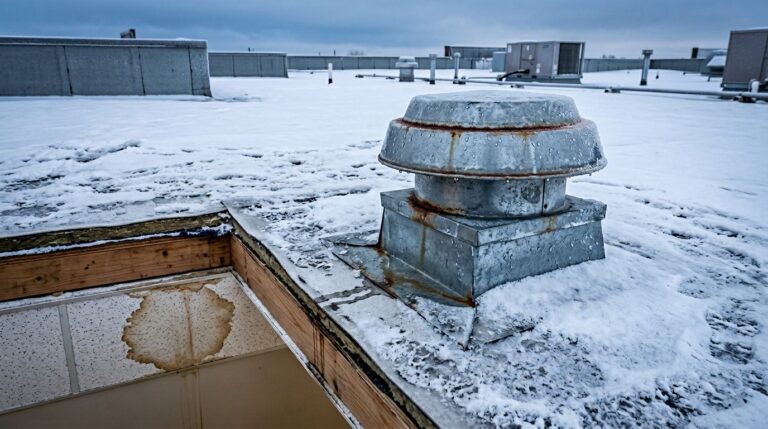
On a low-slope roof, an interior stain is often where water exits, not where it entered.
A commercial flat roof can carry water along membrane laps, insulation boards, deck flutes, or framing before it reaches a ceiling tile. Moisture mapping, electronic testing, infrared review, and limited test cuts can show whether damage is isolated or spread across connected roof areas.
Repair scope affects the period of lost rent
A targeted commercial roof repair may be enough when the damage is limited and insulation remains dry. Commercial roof restoration or commercial roof coatings can extend the service life of a sound system, but neither fixes saturated insulation, failed attachment, open flashings, or storm-created punctures.
Commercial roof replacement may be the honest scope when moisture is widespread, seams fail across connected areas, or repeated repairs have not held. A hail damage roof claim also needs proof of functional damage. This is important on metal roofing, where dents may be excluded as cosmetic unless seams, coatings, clips, drainage, or weather resistance changed.
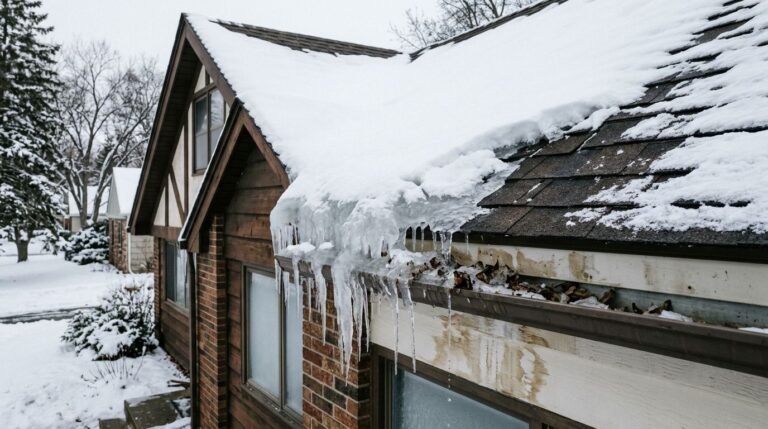
Ice dam removal can limit additional water entry during winter. It does not, by itself, prove a covered cause of loss or settle the coverage question.
Minnesota Details That Affect the Claim
Cold weather and mixed-use buildings complicate causation
Minnesota roofing claims often involve wind-driven rain, snow loading, freeze-thaw cycles, ice buildup, and aging materials at the same time. In Saint Paul roofing files, as in Minneapolis roofing files, the contractor report should separate new storm damage from old repairs, drainage defects, and deferred maintenance.
Twin Cities roofing reports should also account for mixed-use structures. A building may have a commercial membrane roof above retail space, asphalt shingles over entries, and residential units above. Keep commercial losses separate from residential roof repair or residential roof replacement costs. Code-required insulation, edge metal, or drainage work may also require an ordinance-or-law endorsement.
Use a contractor report that stays within the facts
A roofing contractor documents roof condition and repair scope. The insurer decides coverage. The strongest report identifies the damaged assembly, states the likely cause, maps moisture, and explains why repair or replacement is required.
Sellers Roofing Company, established in 2017 at 801 Transfer Road in Saint Paul, has completed more than 1,100 roofs, including 300 commercial projects. Its MN Builder Contractor license, MN License 803862, and union-built roofing crews, including IUPAT Local 96 roofers, support detailed field documentation. A GAF certified contractor should still separate storm damage from maintenance issues in writing.
For a cause-based report on a low-slope building, Get a Free Commercial Roof Inspection.
Conclusion
Lost rent is not automatic because a roof leaks after a storm. The policy must include time-element coverage, the storm must be covered, and the physical damage must cause a measurable interruption.
A clean file links the roof opening, tenant impact, repair schedule, and measurable rental loss. That is the record an adjuster can evaluate.
Frequently Asked Questions
Can I claim lost rent if my tenant keeps paying?
Usually not for the same rent. Rental-value coverage is based on the income you actually lost. A tenant that keeps paying may eliminate or reduce that part of the claim.
What if the building was partly vacant before the storm?
Vacancy rules can change the result
Partial vacancy does not always bar coverage, but the policy may reduce or exclude coverage after a building has been vacant beyond its stated threshold. Provide occupancy records and leases for the period before the loss.
Does lost-rent coverage pay a tenant’s lost sales?
Not under the landlord’s rental-value coverage. A restaurant, retailer, or office tenant may need its own business-income insurance for lost revenue. The owner’s claim is generally limited to unpaid rent and covered continuing expenses.
Can ordinance-or-law coverage extend lost-rent payments?
It can affect the repair cost and sometimes the restoration timeline, but it depends on the policy wording. Code-required upgrades are not automatically included in a commercial property form.
What if the insurer calls metal roof damage cosmetic?
Ask for a written explanation and compare it with the roof findings. Dented panels may still have functional damage if seams, concealed clips, protective coatings, flashing, or drainage were disturbed.
For the larger documentation and claim process, read our Minnesota roof storm damage and insurance claims guide.
Need a roof inspection in Saint Paul or the Twin Cities? Call Sellers Roofing Company at +1-651-703-2336 or schedule a free estimate. We are a black-owned, NMSDC-certified MBE roofing contractor with 9+ years experience.