Last updated: 2026-08-01 by Ted Sellers, Owner
Yes. On many commercial roofs, water enters at one point, then travels along seams, insulation, metal deck flutes, or framing before it drips inside. That means a ceiling stain can appear several feet away, sometimes much farther, from the actual roof damage. The interior drip marks the exit point, not always the entry point.
If you manage a warehouse, office, church, condo, or retail building, that distance matters. A patch placed right above the stain can miss the real opening and leave hidden moisture in place.
Water follows the path with the least resistance. Once you know where it tends to move, the inspection gets faster and the repair scope gets smarter.
When This Applies
Large low-slope roofs are where this happens most
This is common on commercial roofs with TPO, EPDM, modified bitumen, coated systems, and metal panels. It also shows up on buildings with mixed roof types, such as a flat main roof with steep-slope accents.
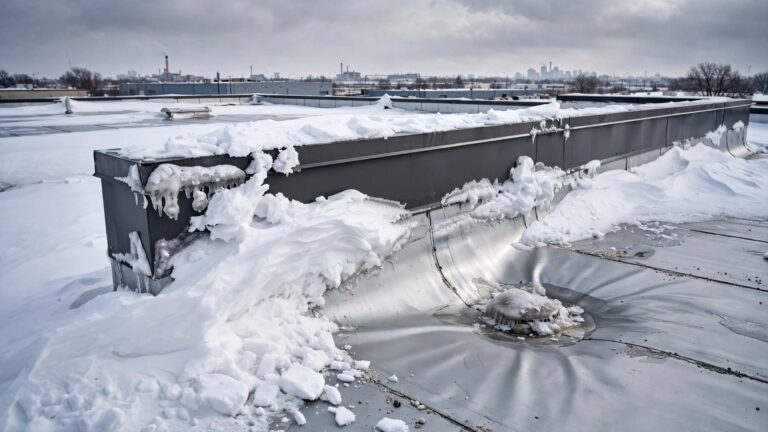
On these assemblies, water doesn’t always drop straight down. It can move under membrane laps, through insulation joints, along steel deck ribs, or beside curbs and parapet walls. Wind-driven rain makes this worse, because openings often start at edges, corners, flashing, and penetrations.
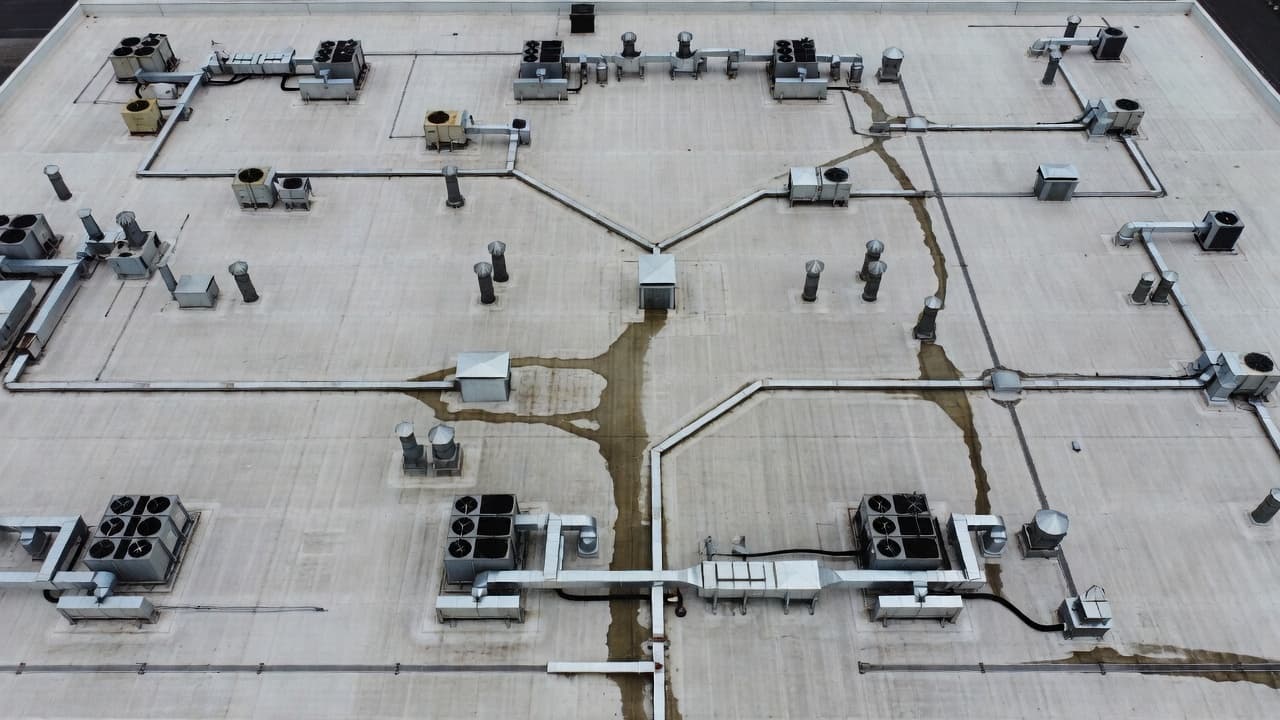
If the stain location doesn’t make sense, professional commercial roof leak detection can trace the moisture path before crews open the wrong area.
When it does not fully apply
This is less common on small, simple steep-slope roofs with open attic access, where water often drops closer to the breach. Even then, valleys, underlayment laps, and flashing can still move water sideways.
There are also false alarms. A drip might come from plumbing, HVAC condensate, attic frost, or indoor humidity, not the roof. If the water appears only when cooling equipment runs, or only during freeze-thaw cycles, the source may be inside the building system, not above it.
The key exception is pattern. A storm-related roof leak usually lines up with recent wind, hail, or heavy rain. A moisture problem from condensation often follows temperature swings and indoor humidity instead.
Why Water Can Show Up Far From the Source
Hidden paths above the ceiling
Commercial roofs hide a lot of travel space. Water can run between membrane layers, across a cover board, through wet insulation, and down a deck flute before gravity finally wins. By then, the drip may land in a hallway, tenant suite, or stock room far from the opening.
The ceiling stain is often the end of the water’s trip, not the start of it.
For commercial owners, a roof leak far from its source is common enough that good inspectors don’t chase the stain first. They trace the likely path backward.
Storm damage changes where water moves
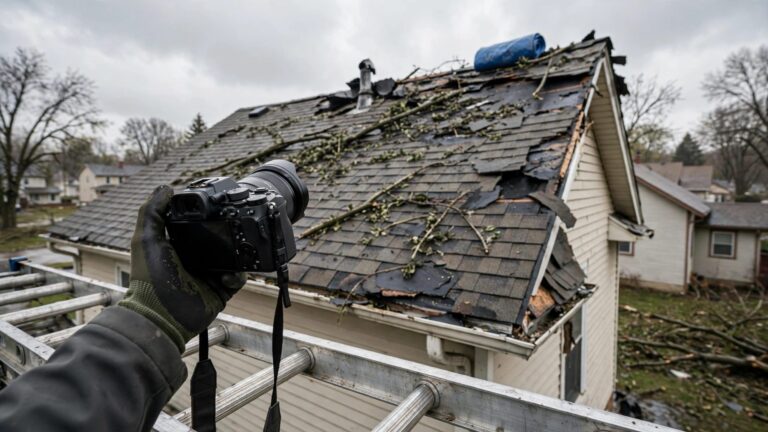
Wind can lift a seam without tearing it wide open. Hail can bruise a membrane or crack a flashing corner. A backed-out fastener can loosen metal just enough to admit water. In each case, the opening may look small while the moisture spread grows quietly across connected materials.
That’s why timing matters. Some leaks show up during the storm. Others wait until the next rain or thaw, after water has already traveled.
Fresh damage also has a different look than age-related wear. Storm problems are often uneven and concentrated at perimeters, corners, ridges, penetrations, or the wind-facing side. Older wear usually looks more uniform.
Step-by-Step
What to do the same day
- Protect people and property first. Move inventory, place containers, and shut off power near active drips if water is close to electrical equipment.
- Photograph the stain, the floor, damaged contents, and any visible roof conditions. Write down the time, the weather, and who first noticed the leak.
- Call your insurer if the leak followed a storm or other covered event. Ask whether emergency mitigation is allowed while you wait for inspection.
- Keep mitigation temporary. A tarp, drain clearing, wet-vac work, or a small temporary seal can limit damage without destroying evidence.
How to narrow down the real opening
- Keep maintenance staff off a wet or storm-damaged roof. Slick membranes, hidden soft spots, and damaged decking can turn a small leak into a safety event.
- Start the roof inspection at edges, corners, flashing, rooftop units, drains, wall transitions, and penetrations up-slope from the interior leak. Water rarely drops in a straight line on a commercial roof.
- Bring in a team that handles commercial roofing services in Saint Paul if the building has multiple roof systems, recurring leaks, or heavy rooftop equipment.
- Use moisture mapping, infrared, or targeted test cuts when the path isn’t obvious. Large roofs can hide wet insulation far beyond the first drip.
- Separate fresh damage from old wear in the report. That distinction matters for repair decisions and for insurance disputes.
- Wait to approve permanent work until the scope is clear. A small opening may need a patch, but connected wet areas can turn that job into section work or more.
When a Small Leak Means a Bigger Roofing Problem
How to tell repair from replacement
Sometimes the leak is local. If the membrane still bonds well, the insulation is dry, and the damage sits in one detail, a commercial flat roof repair is often enough.
Other times, the stain is only the warning light. Widespread wet insulation, soft spots, repeated leaks, open seams, failed edge attachment, or membrane shrinkage point to a broader system failure. In that case, commercial roof replacement may cost less over time than repeated patching.
This quick comparison helps frame the decision:
| What the inspection finds | Likely action | Why | | | | | | One puncture or one failed flashing detail, dry surrounding insulation | Commercial flat roof repair | The failure is isolated | | Wet insulation across connected areas | Larger section repair or replacement | Moisture spread exceeds the visible leak | | Repeated leaks, open seams, soft spots, failed attachment | Commercial roof replacement | The system is no longer dependable | | Mixed roof types with one damaged area | System-specific repair plan | Each roof assembly fails in different ways |
A small ceiling mark can be the first sign that the commercial roof needs repair across a larger area. That is especially true after wind events, because one lifted edge can open the door for wider moisture spread.
Good documentation keeps that from turning into guesswork. Photos, moisture readings, test cuts, and notes about recent weather help show whether the problem is local, connected, or system-wide.
Conclusion
The takeaway
A roof leak can show up far from the damage, and on commercial buildings that happens all the time. The drip inside tells you where water finished moving, not where it got in.
That difference shapes every next step. It affects the inspection, the repair scope, the insurance file, and whether the right answer is a patch or a larger project.
When you follow the water path instead of the stain, the fix usually becomes clear.
FAQs
Can water travel on a metal roof before it drips inside?
Yes. It can move along panel laps, clips, fastener lines, underlayment, purlins, and wall transitions. A stain at the ceiling grid may sit well away from the loose fastener or failed flashing above.
Should I open the ceiling where the stain appears?
Only if you need to protect people or property. Opening the ceiling can help drain trapped water, but it won’t always show the roof entry point. Photograph everything before removing wet materials.
What if the leak only happens during wind-driven rain?
That often points to flashing, edge metal, wall transitions, or rooftop equipment curbs. Those details can stay dry in calm rain but leak when pressure pushes water uphill or sideways.
Can a small stain still mean a major roof problem?
Yes. One stain can reflect widespread hidden moisture. Wet insulation can carry water beyond the visible drip, so the interior mark may understate the real scope.
Will insurance still cover it if the drip is far from the roof damage?
Coverage usually turns on the cause of loss, not on where the stain appears.
If the adjuster can’t inspect right away
Keep the building protected with temporary measures, save receipts, and continue taking dated photos. That record helps show the leak path, the timing, and the effort you took to limit further damage.
Need a roof inspection in Saint Paul or the Twin Cities? Call Sellers Roofing Company at +1-651-703-2336 or schedule a free estimate. We are a black-owned, NMSDC-certified MBE roofing contractor with 9+ years experience.